Old Video Camera
I'm Thinking of Ending ThingsThe Old Video Camera turns an unfamiliar room at the Rural High School into a scene of surveillance. Its playback gives the narrator a moving view through the building and toward the Old Pickup Truck, but leaves crucial facts uncertain: the person filming is never identified, and the driver who appears to be Jake cannot be confirmed. The device supplies evidence without resolving the danger, making it both a practical clue and a source of deeper uncertainty.
Placement and physical details
The narrator discovers the Old Video Camera on the far side of a desk, beside a small shirt recognized as one from the narrator’s childhood. The shirt is light blue with white polka dots, a ripped sleeve, and a tiny paint stain along the spine. The close placement makes the two objects an arresting pair: one calls up a personal past, while the other is poised to show the narrator something about the present. The evidence does not explain how either came to be in the room or establish a connection between them.
The camera is small and old, though still fairly light to lift. Two cables attach it to the back of a television. At first, the screen shows only static. The narrator wants to leave the room, but instead puts the camera back on the desk and tries its play button. The screen flickers, and the static gives way to an image. The camera is therefore not merely an abandoned object or a device the narrator inspects: its playback becomes the means by which the room and the building acquire a threatening recorded perspective.
A recorded route through the school
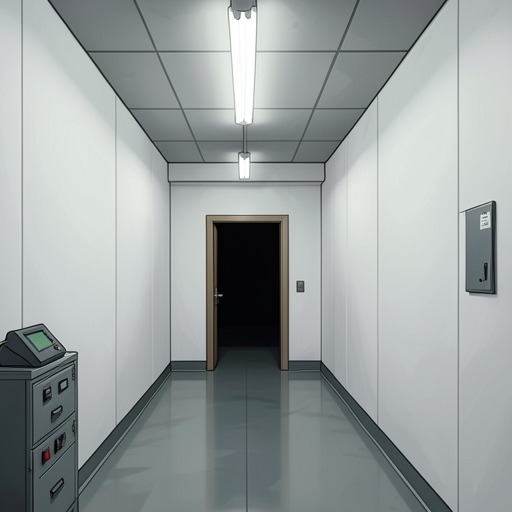
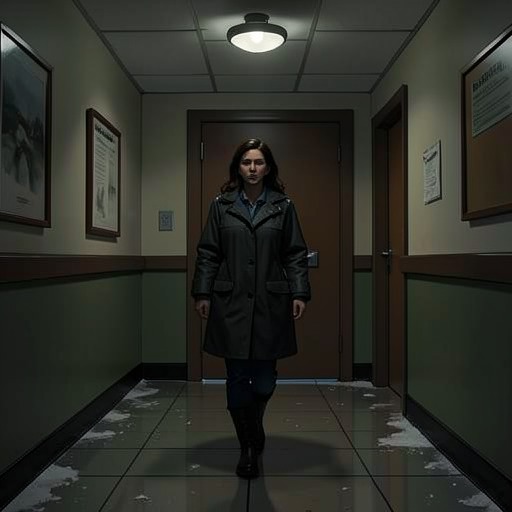
The image first shows a room and a wall. The narrator recognizes details in the shot—the same room, including its wall, photographs, and desk. A sound accompanies the image, described as humming or breathing, though the narrator cannot determine exactly what it is. The camera then points down toward the floor and moves out through the door and along a hall. Slow steps, like rubber boots on tile, can be heard; the pace seems methodical and deliberate.
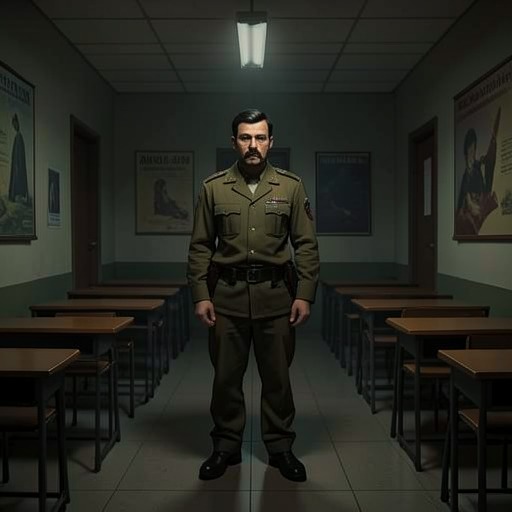
The footage continues into what appears to be the school library. It proceeds straight through rows of communal desks and stacks and shelves of books toward the windows at the back. Once there, it becomes still. A hand, or something resembling one, enters just beyond the frame and shifts a blind slightly; the blind jingles. The camera then moves upward to look outside. This sequence makes the recorder’s presence perceptible through movement and sound, yet keeps the person behind it out of view.
The truck and the uncertain figure
Outside the library window is the Old Pickup Truck, parked at the back of the school. The camera zooms toward it, and the image becomes shakier and less clear. Someone is sitting in the driver’s seat. The narrator thinks the figure looks like Jake, but immediately doubts that identification; the resemblance remains unresolved. The shot ends abruptly, returning to loud, fitful static, which startles the narrator.
The recording does not establish when the truck was filmed or who was in it. Nor does it prove that Jake was present: the narrator’s recognition is tentative, and the poor quality of the zoomed image limits what can be seen. The distinction matters because the narrator later sees that the black pickup is still there while Jake’s car is gone. The two vehicles are not interchangeable, and the later absence of Jake’s car does not clarify who occupied the truck in the playback.
From playback to confinement
After the footage cuts to static, the narrator decides to get out and seek help, unsure who the man in the room is, what is happening, or where Jake is. The camera has shown a route through the building, but it has not provided a safe way out. When the narrator reaches the entrance, a metal chain and lock have been fastened to the door from the inside. Looking back, the narrator concludes that someone has locked it, but does not see who did so.
The narrator then sees that Jake’s car is no longer at the front of the school. A folded note caught in a loop of the chain intensifies the threat, and the narrator becomes afraid that Jake has been harmed and that the unseen person is now pursuing them. Soon, slow footsteps like rubber boots are heard in another hall. These sounds recall the boot-like steps on the camera’s playback, creating a significant echo between recorded movement and the immediate danger. The narrative does not explicitly identify the recorder as the person now moving through the school, so the resemblance raises suspicion without proving identity.
Narrative role and limits
The camera’s sequence changes the narrator’s understanding in stages. It begins as an old device attached to a television; its static briefly makes it seem unusable. Playback then reveals a view of the very room where the narrator stands, followed by a deliberate passage through the school and a glimpse of a possible familiar figure in the truck. Each new image offers more information, but none answers the central questions of who is filming, when the images were made, or whether the figure is Jake.
Its perspective also makes the school feel observed from within. The camera passes through ordinary spaces—a hall, the library, its desks and books—and arrives at windows that frame the truck outside. The shift from an apparent route through the building to a stationary view through the blinds gives the recording the quality of a search or watch, though its purpose remains unknown. By stopping in static rather than supplying an explanation, the Old Video Camera leaves the narrator with vivid sensory clues and no reliable account of what they mean.